Birch Hill2026-10-28 13:08:00Birch Hill raises $4 million seed round to bring U.S. loan markets onchainBirch Hill, a New York startup founded by former Wall Street professionals, has closed a $4 million seed round led by Multicoin Capital, with ParaFi Capital, Castle Island Ventures, and Nascent also participating. The company said the financing brings its total funding to $6.5 million. Birch Hill is building a business around putting U.S. credit products on public blockchains, with a focus on apartment, agriculture, and energy loans. The firm operates through three units: Vaults, which serves as an official curator on Morpho and sets credit and risk parameters; Strategies, which develops onchain credit products such as Birch Hill Absolute Value; and Enterprise, which has applied for FINRA broker-dealer membership to place private credit offerings with verified accredited investors. The company said it met with the U.S. Securities and Exchange Commission's Crypto Task Force in August as part of a longer-term plan to securitize pools of U.S. multifamily, agriculture, and energy loans for onchain holding within the U.S. regulatory framework. Birch Hill is led by CEO Bhavin Vaid, a former Goldman Sachs analyst, and COO Connor Flanagan, who previously worked at BlackRock, Digital Currency Group, and Flipside. The eight-person team also includes three hires from Yearn and one executive from Gauntlet.870
Moody's2026-10-27 17:26:08Moody’s says AI infrastructure borrowing is pushing private credit wider, with refinancing pressure building for 2027-2029Moody’s Ratings said heavy borrowing tied to artificial intelligence infrastructure is expanding private credit beyond the bounds of traditional corporate lending, while a coming maturity wall could make refinancing harder for weaker borrowers. The agency said financing demand now stretches well past data center construction and includes land, power, semiconductors, and computing hardware such as GPUs and TPUs. It expects combined capital spending by the five largest U.S. hyperscalers and AI cloud provider CoreWeave to approach $1 trillion by 2027. Moody’s said funding is coming not only from operating cash flow, but also from debt, joint ventures, and special purpose vehicle structures that can isolate project assets and open the door for private credit to move deeper into technology infrastructure. It also pointed to recent volatility in debt tied to CoreWeave as a sign that investors are paying closer attention to highly leveraged AI borrowers. The agency warned that loan maturities due from 2027 to 2029 will test weaker borrowers in a higher-rate environment. Among 607 borrowers tracked by Moody’s, about 17% use payment-in-kind, or PIK, interest, which lets borrowers defer cash interest by rolling it into principal. Moody’s also flagged circular financing risks involving tech companies, chipmakers, and AI developers that invest in, lend to, and buy from one another.1010
Taiwan centra2026-10-27 06:06:03Taiwan central bank flags AI data center financing leverage as a major global riskTaiwan’s central bank said in briefing materials prepared for Governor Yang Chin-long’s Oct. 28 report to the legislature that uncertainty over AI investment returns and rising financing risks have become one of the main threats to the global economic outlook. The document said large U.S. cloud service providers continue to raise capital spending, but data center projects face four bottlenecks: power supply, equipment availability, local resident opposition, and local government reviews, all of which could delay project launches. The central bank also said emerging cloud companies and data center developers are relying more heavily on private credit, asset-backed financing, and special purpose vehicles, increasing both leverage and financing complexity. Citing Bloomberg, the Bank of England, and The Wall Street Journal, the report said the four largest CSPs — Alphabet, Amazon, Microsoft, and Meta — are facing widening funding gaps as capital spending outpaces operating cash flow. It added that off-balance-sheet commitments and liabilities tied to the four firms total about $2.424 trillion, roughly four times their on-balance-sheet long-term borrowings and lease liabilities. The bank warned that if AI profits and returns fall short of expectations, repricing and credit risks could spread across non-bank lenders and potentially into the banking system.690
Anthropic2026-10-17 06:30:22Anthropic chip financing offers yield above 10% as Blackstone eyes $9 billion commitmentAnthropic has offered a yield of more than 10% on a new chip-financing deal tied to its latest procurement plans, according to a Reuters report citing the Financial Times on Oct. 16. The report said funds managed by Blackstone are expected to invest $9 billion in debt backed by Anthropic’s five-year chip lease payments. Reuters added that it could not immediately verify the report. The financing package, known as Project North Star, is reportedly sized at $60 billion and aimed at securing about 1.5 gigawatts of Google-designed tensor processing units, or TPUs. Of that amount, around $42 billion would be senior debt backed by Broadcom, which works with Google to develop the chips. The subordinated portion is planned at $18 billion, with Blackstone funds expected to take half and the remaining $9 billion to be raised from other investors in the coming months. The report said comparable borrowers with similar ratings typically pay about 7% in the public bond market. Anthropic received a rating from KBRA in June that was one notch below investment grade, and the new subordinated debt is expected to receive a similar rating. The article also said Anthropic raised about $4.4 billion through a similar structure called Project Big Sky four months ago at an 8.5% rate.980
J.P. Morgan2026-10-11 02:35:04J.P. Morgan Asset Management sees value in high-quality corporate bonds as a hedge against AI-heavy portfoliosJ.P. Morgan Asset Management is taking a constructive view on high-quality fixed income, arguing that investors can lock in attractive yields without moving too far down the credit spectrum. In remarks cited from a CNBC interview, investment manager Priya Misra said top-quality corporate bonds are currently offering around 6.5% yields, giving market participants a way to earn strong income without relying on high-yield debt. The firm also said bonds can help offset concentration risk in portfolios that have become heavily exposed to artificial intelligence and technology stocks. Misra said fixed income offers a broader mix of return sources, including U.S. Treasuries and corporate credit outside the tech sector. J.P. Morgan Asset Management has also started extending duration and selectively adding exposure to some BB- and B-rated bonds as credit spreads widen. A similar view came from BondBloxx co-founder Joanna Gallegos, who said current bond yields remain historically attractive. She pointed to solid corporate fundamentals and ongoing economic growth as support for adding corporate debt to portfolios, while also noting private credit and collateralized loan obligations, or CLOs, as additional defensive income options. At the same time, the analysis warned that high interest rates are still weighing on sectors such as real estate.820
Fasanara Capi2026-09-02 20:40:01Fasanara Capital’s Private Credit Strategy Goes Live on Solana via Midas RWAFasanara Capital, an asset management firm, has launched its private credit strategy on the Solana blockchain through Midas RWA, issuing a token called solmF-ONE. The token is now integrated into Kamino's RockawayX RWA USDC market and SteakhouseFi's USDG high-yield market, enabling its use in DeFi activities within the Solana ecosystem. This move aims to bring traditional private credit assets on-chain, offering DeFi users new yield opportunities. The integration bridges traditional finance and decentralized finance, allowing DeFi participants to access yields from private credit assets.1140
HashKey2026-10-08 03:00:59HashKey wealth channel points to a shift from token picking to digital asset allocationA PANews analysis argues that the conversation around digital assets is moving beyond the question of which token to buy and toward a broader issue: how capital should be allocated across different sources of return inside a digital asset account. Using HashKey’s wealth management channel as the main case study, the piece says the industry’s core problem is no longer a lack of assets, but a lack of return streams that behave differently from one another. The article frames this shift through the themes discussed at this year’s TOKEN2049 in Singapore, where tokenization, stablecoins and AI remained central topics. The difference, it says, is that the debate now centers on how these technologies and assets can enter the financial system and be used at scale. In that context, tokenization matters not because it creates more tokens, but because it brings money market funds, fixed income, private credit, global equities and gold into digital asset accounts alongside crypto-native positions such as BTC, ETH and ETH staking. PANews says this changes the path of funds inside a crypto account. Instead of forcing investors to cut risk by selling into stablecoins or fiat and withdrawing, a broader product mix can let them rotate between risk levels without leaving the account system. The article argues that this is the real step from trading toward asset management, and that HashKey’s role is to connect regulated digital asset accounts, tokenized traditional finance products, crypto infrastructure, institutional clients and multi-asset allocation demand.1110
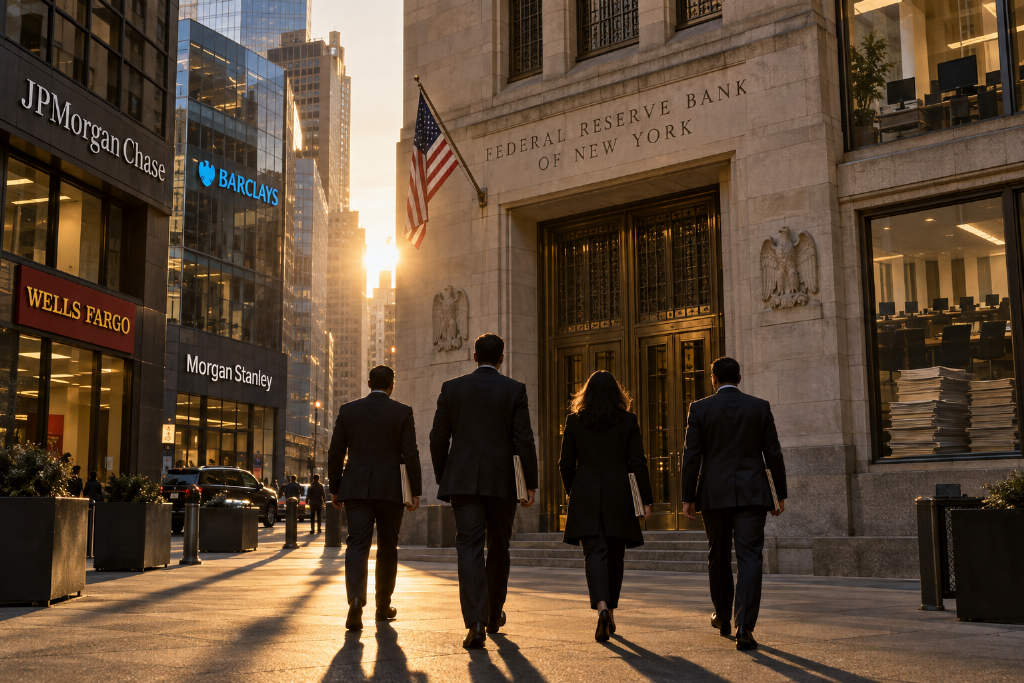
New York Fed2026-10-05 21:02:45New York Fed reviews four banks’ exposure to private credit firmsAccording to Semafor, the Federal Reserve Bank of New York has started visiting JPMorgan Chase, Wells Fargo, Barclays, and Morgan Stanley to review their lending to private credit firms and the risks tied to those exposures. The review is said to be partly linked to JPMorgan’s move in March to mark down a large number of loans in its private credit portfolio. Semafor said those markdowns were particularly tied to loans made to software companies facing pressure from artificial intelligence. The development points to a closer look by regulators at how major banks are managing credit risk in this part of the market.810